Frequently Asked Questions

We’ve had several questions asked regarding the geothermal energy system, so here are a few answers to those questions. We’ll post a few more on our blog as we receive more questions.

How many wells are there?
What is the average, maximum, and minimum well depth?
What is the temperature of the water in the pipes?
Has this ever been done before at a university?
Were there any experts outside of Physical Facilities consulted before the project started?
Will the mall between V.H. McNutt Hall and the Curtis Laws Wilson Library be a new parking lot?
How does a screw type heat recovery chiller work?
Will the geothermal system provide heat or only cooling?

How many wells are there?

645 wells have been installed for the three geothermal plants under construction.

What is the average, maximum, and minimum well depth?

The wells range in depth from 420 to 440 feet.

What is the temperature of the water in the pipes?

The groundwater temperature in this area is approximately 60°F. As the year progresses from predominantly cooling season to heating season, the temperature of the water circulating in the closed geothermal loop and well piping will vary from 90°F to 100°F in the early fall to 40°F to 45°F in the spring.

Has this ever been done before at a university?

Ground source heat pump technology has been around for many years, but only one other university has completed a project of this scale.

Were there any experts outside of Physical Facilities consulted before the project started?

McClure Engineering offered consulting while Physical Facilities was evaluating feasibility.

Will the mall between V.H. McNutt Hall and the Curtis Laws Wilson Library be a new parking lot?

No. This area will be restored to a landscaped pedestrian area.

How does a screw type heat recovery chiller work?

A heat recovery chiller operates on the basis of a refrigeration cycle: the same basic cycle that is used for refrigerators, air conditioners, and heat pumps you find in your homes. It is designed to provide both useful cooling and useful heating energy from the machine. The work or energy put into the machine through the compressor is used to simply transfer heat from evaporator to the condenser, which makes it a more efficient use of energy than combusing fuel for heat.

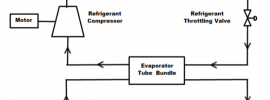
As seen in the diagram below, the refrigerate, R-134a in our chiller, is first compressed using a screw-type compressor. This hot gas is then condensed to a liquid as it travels in a circuit through the condenser, and heat is transferred to the water flowing through the condenser tube bundle.

The pressure and temperature of the refrigerant is reduced as it flows through the throttling valve. The refrigerant next passes through the evaporator where heat is transferred from the water flowing through the evaporator tube bundle back to the refrigerant. Then the cycle repeats as the refrigerant goes back to the compressor. The refrigerant is confined inside of the heat pump chiller for the entire process.

Will the geothermal system provide heat or only cooling?

The heat recovery chiller coupled with the geothermal well fields can be operated to provide heating water only, cooling water only, or can simultaneously provide heating and cooling water, if required.

Heating Water Production

Water from the campus heating water return lines flows through the condenser of the heat recovery chiller, where it is heated to a nominal 120 degrees Fahrenheit for distribution back to campus. The heat transferred from water flowing in the evaporator of the chiller, which has been circulated through the geothermal loop, warms as it circulates through the well fields.

Chilled Water Production

Water from the campus chilled water return lines flows through the evaporator of the heat recovery chiller, where it is cooled to a nominal 44 degrees Fahrenheit for distribution back to campus. The heat is transferred to water flowing in the condenser of the chiller, which has been circulated through the geothermal loop, cools as it circulates through the well fields.

Simultaneous Heating and Chilled Water Production

Water from the campus heating water return lines flows through the condenser of the heat recovery chiller, where it is heated to a nominal 120 degrees Fahrenheit for distribution back to campus. The heat is transferred from water flowing in the evaporator of the chiller, which in this case is water from the campus chilled water return lines through the evaporator of the heat recovery chiller, where it is cooled to a nominal 44 degrees Fahrenheit for distribution back to campus. Geothermal loop water is mixed as necessary through one of the tube bundles to balance the loads on the chiller.

The geothermal system will provide heating in the winter and cooling in the summer.

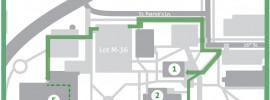
Alternate Routes from Lot M36 and M19

M-36 Route Map

Due to construction on the geothermal energy project, alternate routes may have to be taken to buildings from parking lots M19 and M36. Please see the following map below for alternate routes. We appreciate your patience during this period as we … [Continue reading]

Trenching Continues

Geothermal Progress-010

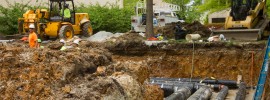
The geothermal project is moving along well, although construction has experienced some delays due the rainy spring weather. Over the past weeks, trenching has largely been focused on the northwest mall area. As progress continues, trenching will … [Continue reading]

Lot 11 Opening Postponed

Lot 11 construction has been delayed, but will be opened by December 21. Please contact Design & Construction Management with any questions at 341-4252. … [Continue reading]

Geothermal Well Drilling Complete

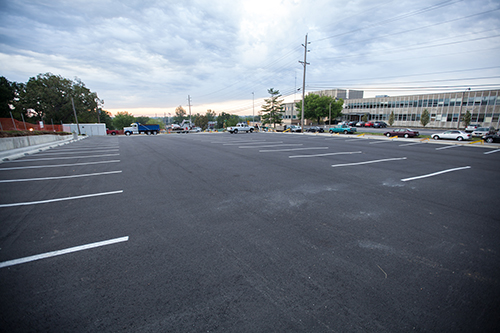
This month marked a major milestone for the geothermal energy system project with the last well being drilled in lot 36 on October 18th. Paving was completed in Lot 8 and put in service early last week for parking and the schedule of the well … [Continue reading]

North Lots Complete

geo-lot

Overall, the well drilling and geothermal header project continues to progress well. Well drilling exceeds 60% completion for the project, the north street crossings have been completed and circuit and header piping back to the Straumanis Plant is … [Continue reading]

Progress Continues With Drilling and Piping

Geothermal%20Drilling-8599-thumb-800x533-27083

Well drilling has continued at a rapid pace with Durbin Geothermal keeping more than four drill rigs on site. Focus has now been directed to the circuit piping in the well fields and header piping back to the geothermal plants to allow the northeast … [Continue reading]

Geothermal Well Drilling Continues

schedule-06-22-12

As geothermal well drilling continues, additional parking spaces are being be displaced. Area C Lot 11 (across 10th Street from Castleman Hall) is scheduled to close at the beginning of July and will be closed until approximately December 2012. Area … [Continue reading]

Lots 8 and 35 Closing May 24

Parking lots 8 and 35 will be closed beginning Thursday, May 24th for well drilling associated with the campus geothermal energy system. If you are an Area L permit holder and you have not already, please notify parking of your alternate choice for … [Continue reading]

Temporary Parking Relocation for Areas L & M

As a result of well field drilling, approximately 10% of university parking lots will be impacted by the geothermal energy project and will be temporarily displaced until well field drilling in the affected areas is complete.  The lots affected … [Continue reading]